Stack Data Structure
This comprehensive guide to Stack Data Structures covers the basics, how to get started, learning techniques, strategies, resources, and common problems to help you effectively understand and use stack in programming.
Stack is a linear data structure based on LIFO (Last In First Out) principle in which the insertion of a new element and removal of an existing element takes place at the same end represented as the top of the stack.
To implement the stack, it is required to maintain the pointer to the top of the stack, which is the last element to be inserted because we can access the elements only on the top of the stack.
LIFO Principle in Stack Data Structure: This strategy states that the element that is inserted last will come out first. You can take a pile of plates kept on top of each other as a real-life example. The plate which we put last is on the top and since we remove the plate that is at the top, we can say that the plate that was put last comes out first.
Representation of Stack Data Structure: Stack follows LIFO (Last In First Out) Principle so the element which is pushed last is popped first.
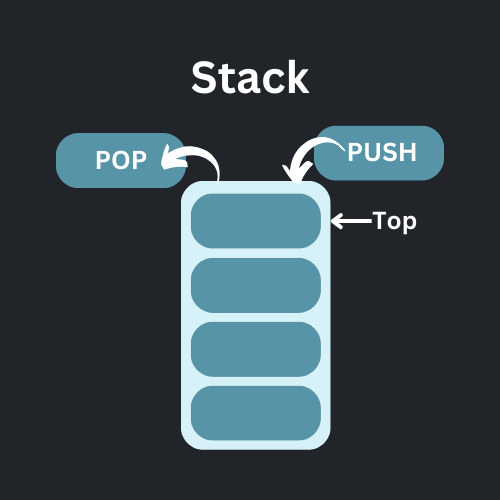
Types of Stack Data Structure:
In order to make manipulations in a stack, there are certain operations provided to us.
Push Operation in Stack Data Structure: Adds an item to the stack. If the stack is full, then it is said to be an Overflow condition.
Algorithm for Push Operation:
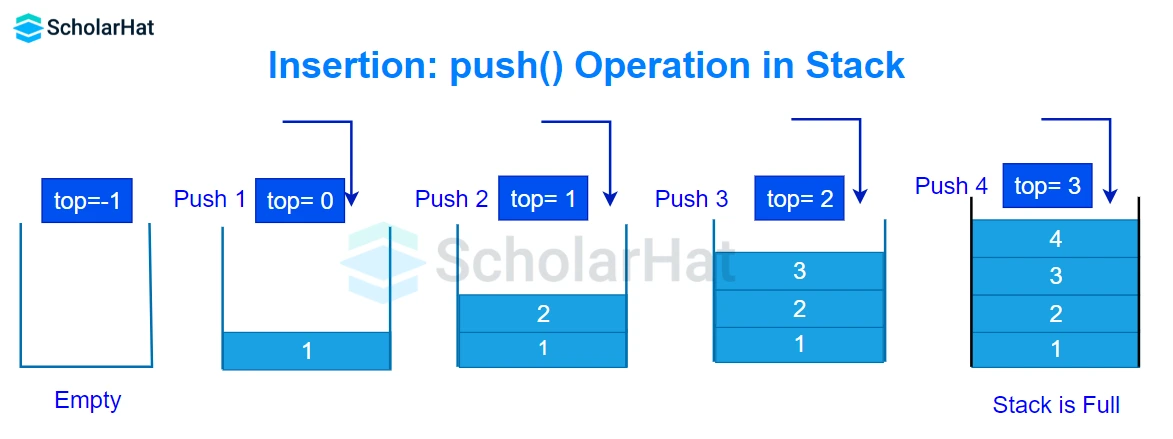
Pop Operation in Stack Data Structure: Removes an item from the stack. The items are popped in the reversed order in which they are pushed. If the stack is empty, then it is said to be an Underflow condition.
Algorithm for Pop Operation:

Top or Peek Operation in Stack Data Structure: Returns the top element of the stack.
Algorithm for Top Operation:

isEmpty Operation in Stack Data Structure: Returns true if the stack is empty, else false.
Algorithm for isEmpty Operation:
isFull Operation in Stack Data Structure: Returns true if the stack is full, else false.
Algorithm for isFull Operation:
The basic operations that can be performed on a stack include push, pop, and peek. There are two ways to implement a stack:
Implementation of Stack Data Structure using Array:
/* C++ program to implement basic stack
    operations */
#include <bits/stdc++.h>
#include <iostream>

using namespace std;

#define MAX 1000

class Stack {
    int top;

public:
    int a[MAX]; // Maximum size of Stack

    Stack() { top = -1; }
    bool push(int x);
    int pop();
    int peek();
    bool isEmpty();
};

bool Stack::push(int x)
{
    if (top >= (MAX - 1)) {
        cout << "Stack Overflow";
        return false;
    }
    else {
        a[++top] = x;
        cout << x << " pushed into stack\n";
        return true;
    }
}

int Stack::pop()
{
    if (top < 0) {
        cout << "Stack Underflow";
        return 0;
    }
    else {
        int x = a[top--];
        return x;
    }
}
int Stack::peek()
{
    if (top < 0) {
        cout << "Stack is Empty";
        return 0;
    }
    else {
        int x = a[top];
        return x;
    }
}

bool Stack::isEmpty()
{
    return (top < 0);
}

// Driver program to test above functions
int main()
{
    class Stack s;
    s.push(10);
    s.push(20);
    s.push(30);
    cout << s.pop() << " Popped from stack\n";

    //print top element of stack after popping
    cout << "Top element is : " << s.peek() << endl;

    //print all elements in stack :
    cout <<"Elements present in stack : ";
    while(!s.isEmpty())
    {
        // print top element in stack
        cout << s.peek() <<" ";
        // remove top element in stack
        s.pop();
    }

    return 0;
}
Output:
10 pushed into stack
20 pushed into stack
30 pushed into stack
30 Popped from stack
Top element is : 20
Elements present in stack : 20 10
Advantages of Array Implementation:
Disadvantages of Array Implementation:
Implementation of Stack Data Structure using Linked List:
// C++ program for linked list implementation of stack
#include <bits/stdc++.h>
using namespace std;

// A structure to represent a stack
class StackNode {
public:
    int data;
    StackNode* next;
};

StackNode* newNode(int data)
{
    StackNode* stackNode = new StackNode();
    stackNode->data = data;
    stackNode->next = NULL;
    return stackNode;
}

int isEmpty(StackNode* root)
{
    return !root;
}

void push(StackNode** root, int data)
{
    StackNode* stackNode = newNode(data);
    stackNode->next = *root;
    *root = stackNode;
    cout << data << " pushed to stack\n";
}

int pop(StackNode** root)
{
    if (isEmpty(*root))
        return INT_MIN;
    StackNode* temp = *root;
    *root = (*root)->next;
    int popped = temp->data;
    free(temp);

    return popped;
}

int peek(StackNode* root)
{
    if (isEmpty(root))
        return INT_MIN;
    return root->data;
}

// Driver code
int main()
{
    StackNode* root = NULL;

    push(&root, 10);
    push(&root, 20);
    push(&root, 30);

    cout << pop(&root) << " popped from stack\n";

    cout << "Top element is " << peek(root) << endl;

    cout <<"Elements present in stack : ";
      //print all elements in stack :
    while(!isEmpty(root))
    {
        // print top element in stack
        cout << peek(root) <<" ";
        // remove top element in stack
        pop(&root);
    }

    return 0;
}
Output:
    10 pushed to stack
    20 pushed to stack
    30 pushed to stack
    30 popped from stack
    Top element is 20
    Elements present in stack : 20 10
Advantages of Linked List implementation:
Disadvantages of Linked List implementation:
The time and space complexity for different stack operations are as follows:
| Operation | Time Complexity | Space Complexity |
|---|---|---|
| push() | O(1) | O(1) |
| pop() | O(1) | O(1) |
| top() or peek() | O(1) | O(1) |
| isEmpty() | O(1) | O(1) |
| isFull() | O(1) | O(1) |